Enterprise Cloud Architecture & Disaster Recovery Blueprint
An in-depth e-book detailing multi-region redundancy, state synchronization, and zero-downtime failover systems.
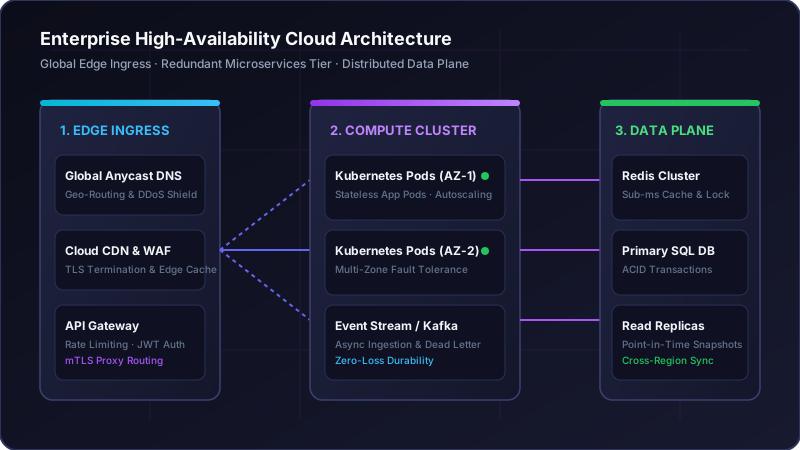
Global Edge Ingress, Redundant Compute Cluster, and Distributed Data Plane.
Enterprise Cloud Architecture & Disaster Recovery Blueprint
4.8 MB PDF · Free Educational Material
Modern enterprise infrastructure requires designing for inevitable partial failures rather than hoping for unbroken uptime. This comprehensive blueprint outlines proven patterns for multi-tier fault tolerance.
Layer 1 begins at the Edge. By deploying Anycast BGP routing combined with edge Web Application Firewalls (WAF) and distributed Content Delivery Networks, TLS handshake overhead is eliminated at the perimeter and DDoS attacks are mitigated before hitting origin servers.
Layer 2 establishes the Compute Cluster. Microservices must be orchestrated as stateless containers distributed across a minimum of three distinct Availability Zones. Kubernetes horizontal pod autoscaling combined with health probes ensures that failed containers are recycled in milliseconds without dropped sessions.
Layer 3 governs Data Persistence. The state layer utilizes synchronous replication within the primary region and asynchronous cross-region snapshot streaming. Read replicas handle reporting and heavy query load, while strict connection pooling prevents exhaustion during traffic surges.
Disaster Recovery protocols must be exercised continuously via automated chaos experiments rather than annual manual simulations. Measuring RTO (Recovery Time Objective) and RPO (Recovery Point Objective) under real conditions provides genuine confidence.
Technical Infographics & Architecture Diagrams
High-resolution architectural blueprints and workflow diagrams for this publication.
High-Availability Multi-Zone Architecture
Cross-zone Kubernetes clusters backed by write-replicated SQL and Redis clusters.
Need direct technical assistance?
Our engineering team is available to assist with custom architectures, cloud migrations, and security compliance.
Contact our engineering team