Zero-Trust Network Security Handbook & Implementation Guide
Comprehensive handbook on implementing Zero-Trust Architecture: identity verification, micro-segmentation, and continuous audit.
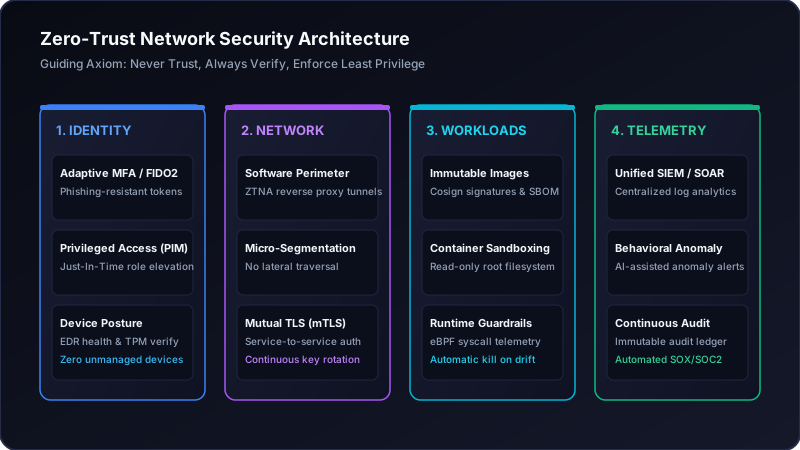
Never trust, always verify: Identity, Micro-segmentation, Workloads, and Telemetry.
Zero-Trust Network Security Handbook & Implementation Guide
3.6 MB PDF · Free Educational Material
The traditional castle-and-moat network security model is obsolete in an era of distributed remote workforces and multi-cloud infrastructure. Zero Trust is not a product; it is a structural operating philosophy.
Pillar 1: Identity & Device Verification. Every access request is authenticated against hardware-backed cryptographic credentials (FIDO2/WebAuthn). Phishing-resistant tokens combined with device posture compliance checks guarantee that unmanaged or compromised endpoints cannot establish tunnels.
Pillar 2: Network Micro-Segmentation. Internal perimeter barriers prevent lateral attack traversal. Even if an individual workload is compromised, software-defined network perimeters and mutual TLS (mTLS) with short-lived certificates restrict communication strictly to authorized upstream dependencies.
Pillar 3: Immutable Workload Sandboxing. Container base images must be cryptographically signed via Sigstore/Cosign with verifiable Software Bills of Materials (SBOM). Runtime filesystems are enforced read-only to defeat arbitrary shell execution.
Pillar 4: Unified Telemetry & Continuous Audit. Every transaction, query, and administrative elevation is recorded into an append-only, tamper-evident audit ledger for automated SOC2 and ISO-27001 compliance verification.
Technical Infographics & Architecture Diagrams
High-resolution architectural blueprints and workflow diagrams for this publication.
Zero-Trust Four Pillars Architecture
Integrated controls spanning hardware FIDO2 authentication, mTLS encryption, and continuous eBPF telemetry.
Need direct technical assistance?
Our engineering team is available to assist with custom architectures, cloud migrations, and security compliance.
Contact our engineering team